This website use cookies to ensure you get the best experience on our website
ContinueUP at the School Innovation Forum 2026: what happens when teacher learning stops being fragmented?
Teachers are expected to navigate uncertainty. They are asked to adapt to technological change, respond to more diverse classrooms and rethink their role in the age of AI. Yet, while expectations evolve, teacher learning itself often remains fragmented.
For many teachers across Europe, the transition between initial teacher education and professional development still feels disconnected. Different institutional cultures, different pedagogical approaches and different priorities can create the impression of starting over rather than continuing a professional journey.
This was one of the central reflections running through the School Innovation Forum 2026. Held in Brussels on 22–23 April 2026, the Forum gathered Ministries of Education, teacher educators, industry partners and Future Classroom Lab ambassadors around a shared question: how can the teaching profession become more connected, collaborative and prepared for the realities teachers face today? Building on the experience of the Teacher Academy projects ContinueUP and 21st Century European Teachers, the event created space to exchange practices and reflect on the future of teacher learning across Europe.
Within this broader conversation, the ContinueUP project focused on the relationship between initial teacher education (ITE) and continuous professional development (CPD). Rather than treating them as separate stages, the project explored how actors across the continuum can work together to create more coherent forms of teacher learning.
Teaching in uncertain times
The tone was already set during the plenary panel “The Anatomy of a Future-Ready Educator”, moderated by Benjamin Hertz, Senior Pedagogical Manage at European Schoolnet. What emerged from the discussion was that the question is no longer simply what teachers need to know, but how the profession itself is changing
During the exchange, Jonna Kangas from the University of Helsinki reflected on how teacher education still often prepares teachers for stable systems and predictable realities, while schools themselves are becoming more uncertain environments. As she put it:
“We don’t know what the future is. So we can’t teach that through the screen or through our research that always looks to the past.”
The comment reflected wider conversations throughout the School Innovation Forum. Across sessions, speakers questioned whether current teacher education structures are truly preparing teachers for complexity, or whether they still rely on models built around stability and the transmission of knowledge.
The discussion also returned several times to the role teachers are expected to play today. Beyond subject knowledge, participants reflected on collaboration and the need for teachers to continue learning throughout their careers.
Bridging the divide between ITE and CPD
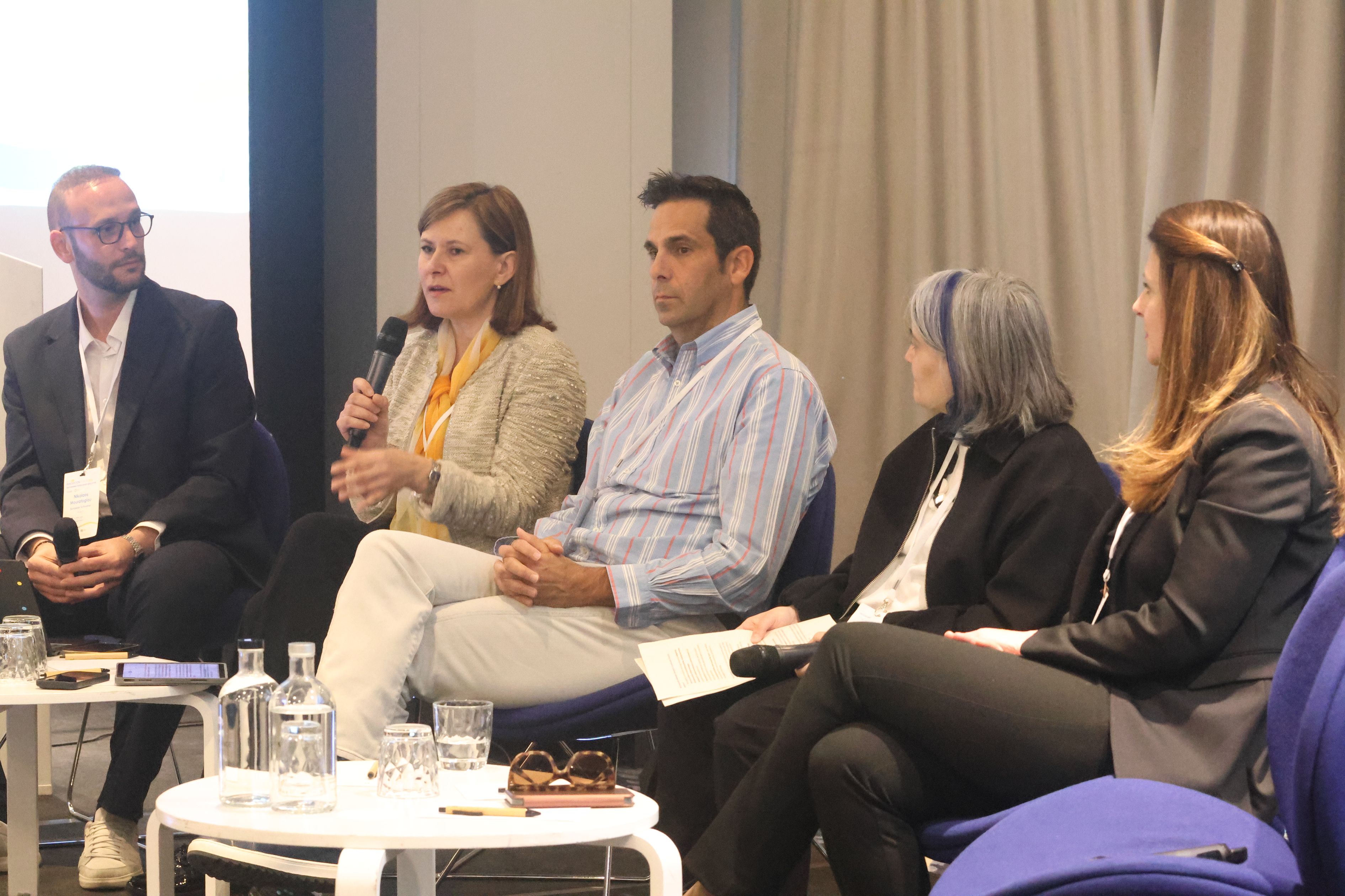
These questions were explored more directly during the plenary panel “Bridging the divide: challenges & opportunities in the ITE-CPD continuum”, moderated by Nikolaos Mouratoglou from European Schoolnet. Bringing together representatives from ministries, universities and CPD providers across Croatia and Spain, the discussion focused less on theory and more on the realities behind collaboration across the continuum.
During the discussion, Višnja Rajić Professor (Assistant) at University of Zagreb described the continuum not as a fixed structure, but as a shared responsibility:
“It is a continuum. It is a lifelong learning process, and we all have ownership over the process of educating and creating teachers.”
Throughout the panel, speakers reflected on how difficult collaboration can become when institutions operate with different constraints, timelines or expectations. Several participants also acknowledged that much of the project’s progress depended not only on formal structures, but on sustained dialogue between partners and the gradual development of a shared understanding across the continuum.
Building continuity across the continuum
This reflection connected closely with the workshop “ITE & CPD in Synergy: Practical Models for Collaboration”, where project partners shared their experience of trying to bridge the divide between pre-service and in-service teacher learning.
Importantly, the workshop did not present collaboration as an automatic process. Discussions focused instead on the realities behind co-construction: limited time, institutional differences but also the challenge of building trust within project timelines.
Participants also returned to the importance of informal exchanges during the project’s study visits. Those conversations, often happening outside formal meetings, became essential for understanding each other’s realities and gradually developing a shared pedagogical language across the continuum.
From project phase to continuing conversation
Still, despite the challenges raised throughout the event, the atmosphere at the School Innovation Forum was far from pessimistic. Many of the discussions suggested that fragmentation across teacher learning is no longer accepted as inevitable.
This perspective was reflected in the closing presentation “What next for ContinueUP?” by Benjamin Hertz. Rather than presenting the end of the project as a conclusion, the session focused on how the work initiated through ContinueUP could continue through future collaboration and experimentation.
Building on this momentum, ContinueUP partners will continue the discussion through future dissemination activities, including an upcoming podcast exploring the formal recognition of teacher learning and possible future directions for accreditation and professional development frameworks across Europe.
Readers interested in exploring the project further can consult the ContinueUP outputs and practical resources developed throughout the project.
By the end of the School Innovation Forum, what remained was not the idea of a perfect model for teacher education, nor the illusion that every challenge facing the profession can be solved through one project. What emerged instead was a shared recognition that teachers cannot continue navigating transformation alone while the systems around them remain fragmented.
Perhaps this is also where the real legacy of ContinueUP lies: not only in the resources produced during the project, but in having created a space where actors across the continuum could stop working next to each other and start learning from one another.



Back >

Funded by the European Union. Views and opinions expressed are however those of the author(s) only and do not necessarily reflect those of the European Union or the European Education and Culture Executive Agency (EACEA). Neither the European Union nor EACEA can be held responsible for them.